This is default featured slide 1 title

Go to Blogger edit html and find these sentences.Now replace these sentences with your own descriptions.

This is default featured slide 2 title

Go to Blogger edit html and find these sentences.Now replace these sentences with your own descriptions.

This is default featured slide 3 title

Go to Blogger edit html and find these sentences.Now replace these sentences with your own descriptions.

This is default featured slide 4 title

Go to Blogger edit html and find these sentences.Now replace these sentences with your own descriptions.

This is default featured slide 5 title

Go to Blogger edit html and find these sentences.Now replace these sentences with your own descriptions.

This is default featured slide 6 title

Go to Blogger edit html and find these sentences.Now replace these sentences with your own descriptions.

Showing posts with label breton matrix 800. Show all posts

Friday, 18 March 2016

Breton = Leading edge technology


With the purchase of Breton's new high speed 5-axis vertical machining centre for milling of parts in superalloys, steel, aluminium and engineered materials, Focus On Molds can assure its customers the impeccable quality standards befitting the company's high reputation on the market.. 
(by Edoardo Oldrati and Flavio Della Muzia - TM)


High machining quality, prompt delivery, reliability and competitive pricing are the cardinal points of Focus On Molds' strategy. Specifically, since 2002 and with the current management at the helm, the company has followed a continual path of growth leading to its current status as one of the most widely recognised toolmakers for the automotive industry in Italy and worldwide thanks to a workforce of more than thirty experts engaged in the design and production of moulds for injection moulding, die casting and semi-solid metal casting.


Operating primarily on the European market, which accounts for around 80% of sales, Focus On Molds has implemented a long-term development plan that saw the 2011 acquisition of the current production site in Cologne in the north Italian province of Brescia, previously headquarters of Astornova, an engineering concern specialised in series machining operations that has now become a member of the Focus On Molds group

In parallel with this initiative, in 2004 company management also incorporated a new company called Plastinject on the Bedizzole site. The newly-formed company is dedicated exclusively to testing the moulds produced both by Focus On Molds and by other toolmakers that turn to Focus On Molds to make their samples. 


Specialists in the automotive industry
«Our operations are mainly addressed to the automotive industry to which we dedicate our full resources, receiving 3D models of the parts and then moving on to the mould project development step in close liaison with the customer, through to production and testing of the part with the customer's assistance at Plastinject – In the words of chairman/CEO Giuseppe Ghilardi, : "Basically it's a full turnkey service  - We've got an engineering department in which our designers use the latest CAD tools to translate the customer's needs into tooling for their production processes, frequently operating in a co-design formula with the companies involved in order to arrive at the most suitable shapes for moulding». 
The Cologne plant produces moulds from 2 to 20 tonnes in weight, with the facility for parallel production and handling of multiple jobs in response to the fast-moving needs of today's market with its obsession with ever shorter lead times from the initial quotation to delivery of the product, with the not infrequent complication of additional requests that reach our company even when mould production is well advanced.


This dynamic has forced the Brescia company to embark on an internal reorganisation process in order to optimise all the management stages and boost its flexibility, starting from the employment of increasingly highly qualified personnel. 
«Another key factor was the upgrading of capital equipment, currently consisting of around twenty advanced machining centres capable of producing exceptionally high quality products with stable and efficient processes.
Giuseppe Ghilardi explains: "One of the basic requirements we consider when choosing our machines is their ability to work within these very tight production times, with the facility to work over several shifts and in unmanned conditions, at high speed and precision: with these requirements in mind we analysed the market offering carefully and decided to contact Breton to order the Xceeder line, which matches all our specifications in full.
In fact, we got to know the company back in 2004 when we purchased an excellent Matrix series machining centre that we continued to use until our 2011 relocation, after which we purchased a new 5-axis gantry machine – again from the Matrix series – that's still hard at work in the plant to our full satisfaction
So on the back of our positive experience, since we needed a new high-speed machine with 5-axis control and turntable, we decided to contact Breton once again».


Having reached the position of a point of reference in the production of multi-function high-precision machining centres, the company based in Castello di Godego (Treviso) currently has a 700 strong workforce engaged in the design and construction of high-tech systems for multiple industrial sectors including aerospace, automotive, shipbuilding, energy, toolmaking and the manufacturing industry in general.


Top-level performance
Designed to meet the most exacting requirements of companies working in the aeronautical, precision engineering and toolmaking industries, the new Xceeder CNC plant forms part of the innovative range of high speed vertical machining centres produced by Breton, with gantry architecture, advanced Metalquartz technology and a direct-drive rotary tilting table. 
Capable of guaranteeing high throughput rates, with compact dimensions and higher rigidity than a steel or simple polymer composite frame, Xceeder has a vibration absorption coefficient that is 10 times greater than that of cast iron, combined with impeccable dynamic performance that forms a benchmark in the machining of complex parts on 5 axes.


The special thermally symmetrical structure and the temperature stabilising systems also guarantee the utmost accuracy of machining processes regardless of changing environmental and working conditions in the 900 RT version, which offers a generous working range with travel of 900x900x700 millimetres on the X, Y and Z axes, speeds of up to 60 m/minute, an 800 mm diameter worktable, and continuous "C" axis and "A" axis with rotation from +110° to -30°, capable of handling loads of up to 1000 kilos.
The unique characteristics of the Xceeder are completed with 4 different electrospindles, all with an integral temperature control circuit, the first of which with power of up to 85 kW, 300Nm of torque in S1, 480Nm in S6, and rotation speed of 14,000 rpm. This electrospindle makes it possible to machine even with special alloys such as Titanium and Inconel with the maximum chip removal capacity. 
The second and third electrospindles, with power of 40 kW, torque of 100 and 64 Nm respectively, in S1, and rotation speed of 18,000 and 28,000 rpm, ensure the maximum versatility of the machine when working with lightweight alloys, while the fourth electrospindle, which is especially suitable for superfinishing and machining of aluminium and engineered materials, reaches 40,000 rpm while maintaining the same power as the two preceding electrospindles.
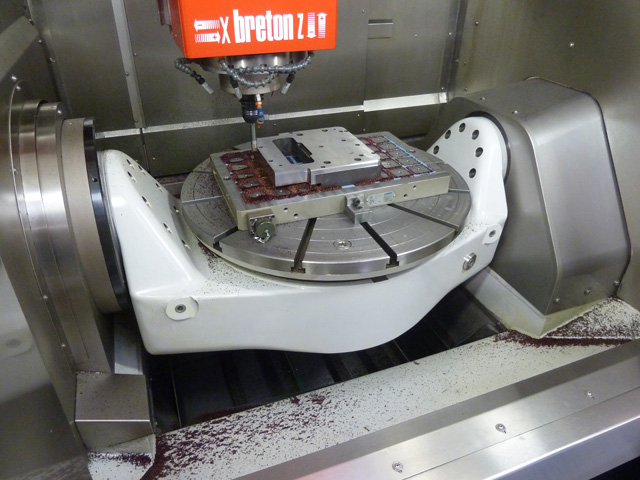


Finally, all versions of the machine can be equipped with a tool magazine with up to 200 positions, automatic pallet changer and a full range of optionals capable of meeting the most complex requirements. «We use this machining centre in our production shop to perform multiple tasks and, primarily, to produce special screw anchors (with a consistent finish level and very tight tolerances) that the machine can produce to unparalleled quality levels – adds Mr Ghilardi - We are extremely pleased with the performance of our new Exceeder, also because it complies with the logic around which we have organised our production cycles, which are usually managed over a single shift, optimising the work processes on the machine, with automated 30-position tool changer, to exploit the facility for unmanned operations in the plant to its full potential».


In addition, as underscored by Mr Ghilardi, one of the main distinguishing features of the Brescia company is their diligence in their production operations, which are conducted with the utmost transparency towards the customer, who is provided with a feasibility study of the part involved showing, right from the pre-sale stage, any criticalities to be discussed together before proceeding.


So thanks to the new Breton machining centre, Focus On Molds is now able to guarantee compliance with sampling start times, a highly critical requirement to maintain the confidence of customers who are thus reassured that they can always rely on the Cologne-based company. «The role of our internal quality control function is essential throughout this process: in relation to the moulds, we use qualified external consultants responsible exclusively for validation activities, because having an external and unbiased assessment helps to ensure our customers get the quality levels they rightly expect from our company – concludes the Focus on Mold chairman and CEO – a quality level that we are able to achieve thanks also to constant updating of our designers and engineers, who receive adequate training in relation to the mechanical aspects and, especially, in relation to software (a constantly evolving field) and the types of tools available on the market time by time».


For INFO and request about 5-axis machining centre Matrix 800 and Xceeder write now to mail@breton.it
Well, that’s all for today. 
Bye-bye 
Sergio Prior


Tuesday, 25 August 2015

Breton Matrix 800 - Interpolated 5-axis high-speed machining centre for milling steel, aluminium, composite materials and resin

Pure flexibility

High-speed precision machining centre for milling complex three-dimensional work-pieces that require accurate machining and continuous axis interpolation. Matrix 800 is the ideal solution to satisfy production requirements in the aerospace and automotive, toolmaking and design industries.


Easy access and perfect visibility
Matrix 800 allows optimal accessibility and visibility of the working area thanks to its large front doors and gantry structure.


Precision and Flexibility when machining at high speed with 5 continuous axes
As a guarantee of high performance Matrix 800 is equipped with heavy-duty shoulders built with innovative Metalquartz technology:  an high tech material including special resin and a high percentage of quartz to guarantee optimal vibrations dampening and the same thermal expansion as the metal structure it self for enhanced surface finishes and longer working life of the cutting tools.


A Superior Head
All electrospindles offer the highest performance thanks to the cast-iron fork head, which gives both structural rigidity and the ability to absorb machine vibrations.


High-speed, Performance and Accuracy
Carriage and beam travel on generously sized recirculating roller guideways to ensure precision and stability. Axes are moved by a ground recirculating ball screw systems. Optical linear encoders ensure maximum axis positioning precision. All axes are powered by the latest generation brushless servomotors controlled by digital drives.


Electrospindles and Tool magazine
Matrix 800 machining centre can be supplied with a choice of electrospindles depending on the type of material machined.Precision is always guaranteed by the spindle thermal stabilisation system and software compensation of the natural thermal expansion that could be caused by changing operating conditions.
Matrix 800 is available with wheel-type tool magazine with min. 30 tools (150 tools max) installed outside the working area to protect it from dirt and ensure the maximum reliability through time.Tool magazine can be equipped with an automatic tool coding system with chip. 

M 48/28
An electrospindle with 20 kW power rating, continuous torque in S1 of 48 Nm and 28,000 rpm is the most appropriate choice for companies that need to perform high speed machining of steel and aluminium, from semi-finishing to precision finishing.

 M 64/28
An electrospindle with 37 kW power rating, continuous torque in S1 of 64 Nm and 28,000 rpm is the most appropriate choice for companies that need to perform high speed machining of steel and aluminium, from roughing to precision finishing.


Roof-top bellows and Dust extraction
Ideal for machining aluminium and composites, Matrix 800 can be equipped with an efficient extraction system for composite materials dust installed on the spindle nose, and roof-top bellows that completely seal the working cell, isolating the machining zone from the outside environment.Various alternative fumes and dust extraction systems are available in accordance with specific customer requirements.


The ideal cooling system
Depending on the type of machining, the tool cooling system can use coolant outside or through the spindle (mac 60l/min) with fixed or variable internal pressure up to 70 bar, incorporate a spray mist system or simply use compressed air.

Monitoring and in-process inspections 
Matrix 800 can be equipped with a laser tool presetter and a radio frequency probe to acquire work-piece dimensions and coordinates, so to simplify the worpiece setting.


For INFO and request write now to mail@breton.it
Well, that’s all for today. 
Bye-bye

Sergio Prior

Thursday, 4 June 2015

From aluminium to steel with zero problems with Breton MATRIX vertical machining centre

Demo Technology chose the Matrix 1000 Dynamic CNC machining centre with 5 continuously interpolated axes to produce finished steel and aluminium dies for the automotive industry. Stiffness and flexibility are the winning features of Breton's solution.
(by Davide Davò and Andrea Pagani for June issue of Tecnologie Meccaniche)

People who work in the automotive industry are used to a frenetic pace of production, shrinking delivery times and constant project changes before final approval. These factors are all too familiar not only to the world's car makers but also throughout their supply chain among so-called tier 1 companies. To make their products, suppliers in turn rely on another tier of vendors, the tier 2 companies, which must work within even tighter schedules for obvious reasons, offering the utmost rapidity and flexibility in meeting the broadest possible range of requests. This situation is well known to Demo Technology, a company based in northern Italy in Pionca di Vigonza (Padua) having several decades of experience in the production of metal dies for the automotive industry. Demo Technology has recently purchased one of Breton's Matrix 1000 Dynamic machining centres to streamline its production of aluminium and steel dies, thus further increasing the company's production flexibility.


Castings and dies
«Our company was incorporated in 1974 under the name Demo Meccanica – explains Demo Technology owner Gherardo Demo. From 1974 to 1985 we operated in the foundry sector as patternmakers, initially making wooden patterns and then progressing to metal patterns. In 1985 we purchased our first 5 axis CNC machine tool - a major investment that gave us a competitive advantage. In 1990 we extended our operations to the tooling industry, producing dies for gravity casting, low pressure casting and pressure die casting. We have been specialised in the production of dies for wheels for around ten years, although this sector suffered a sharp decline in the early noughties, obliging us to approach a different group of customers, while remaining in the automotive industry».


In 2010 the company demerged into two entities working independently, although remaining in close contact: Demo Technology and Demo Modeltech, the former specialised in the toolmaking industry and the latter in patternmaking. Demo Technology today produces tooling for lots of industrial processes (injection moulding, pressure die casting, etc.) for customers operating in the automotive sector. Remaining in the automotive industry, the firm also produces gauges and jigs for checking components such as doors and bumpers.
«In recent years we've invested heavily in machinery and in the engineering department – explains Demo – With regard to plant, we currently have five 3-axis CNC machine tools and six 5-axis CNC machining centres, half of which with continuously interpolated axes, which allow us to produce small series of medium and large size parts».


The acquisition of the very latest technological solutions is a necessary by-product of market evolution, resulting in demand for parts with increasingly complex shapes and hence dies with geometrical features that are ever harder to machine. Evolutionary changes have also affected the methods used by customers to send us the specifications of the components they need.
Gherardo Demo continues:  «Around ten years ago our customers stopped supplying drawings of parts and replaced them with the mathematical characterisations. This led to the need to procure CNC machine tools and, above all, to ensure our engineering department was capable of handling the incoming data and processing them with computerised design and simulation tools. In this process our customers supply the geometrical characteristics of the part and specify the working life required of the tool. It's then down to us to design the tool in such a way that it is optimised for the production of 30,000 parts or to guarantee one million production cycles».


Multiple criticalities, one solution
Geometrical complexity is therefore one of the technological criticalities that the Veneto based company is faced with, plus the need for extreme precision of machining work and impeccable surface quality of the finished die.
«Each sector has its own problems – notes Demo – With regard to the production of jigs and gauges, for example, we need to guarantee tolerances in the region of tenths of a millimetre on parts of up to 1500 mm in length and with complex morphology such as doors, bumpers and chassis members. Conversely, with regard to dies, one parameter of primary importance is the aesthetic appearance of the part so that in addition to guaranteeing compliance with tolerances and surface roughness specifications  the surface must also be completely uniform and free of machining marks left by the mill, or, as in past times, by the operator performing manual polishing operations. That's why in recent years we've invested in increasingly high performance plants, capable of precision machining work and able to finish parts without removing them from the machine».
These criticalities are further compounded by the frenetic nature of automotive industry activities, which call for speed and mental and productive flexibility to provide an ultra-quick response to requests for a range of extremely diverse products.
«The 5-axis CNC machines in our factory allowed us to work on aluminium dies with optimal results – continues Demo – The production of steel dies has been similarly successful, but we realised that our existing machine tools were working close to limit conditions, especially in the case of series of 20 or 30 parts. That's why we started to seek a more robust solution in a process that terminated with our recent purchase of a Matrix 1000 Dynamic machining centre with 5 continuously interpolated axes, made by Breton».


Bigger and more robust
The Padua-based company had already purchased a Matrix 800 in 2001 and, having confirmed the validity of the solution in terms of precision, productivity, finished part quality and reliability, they decided to contact Breton again to choose a new plant.
«We opted for the Matrix 1000 Dynamic mainly due to its ruggedness – explains Demo – To excel in our sector we have to be proactive in responding to our customers' needs, and that means that we need machines that can handle aluminium finishing or heavy chip removal on steel without problems. Our existing Matrix 800 handles both tasks correctly, but thanks to its enhanced rigidity the Matrix 1000 Dynamic model is ideal for removing large volumes of chips when working with steel, while assuring precision in the region of hundredths of a millimetre».


The machine's ruggedness is the result of the Metalquartz frame employed by Breton. The machine's shoulders are composed of a sandwich structure made of stabilised arc welded steel, with ribbing embedded in a quartz composite material with a polymeric matrix. In addition to imparting a high level of structural rigidity, this technology offers excellent vibration damping, which translates into a superior surface finish and longer working life for the milling tools. In addition to the qualities listed above, the machine features generously sized recirculating roller guideways that further increase its structural solidity while simultaneously supporting maximum rapid traverse speed of 60 m/min on the X and Y axes.

«The choice of the Matrix 1000 Dynamic was also based on the need for a longer Z axis stroke – explains Demo – In the execution of angled machining and when working with long overhang tools we needed to pay careful attention to the tool path to avoid collisions with the workpiece. This problem has now been removed with the new machine, which with its additional 200 mm stroke on the vertical axis is able to follow the paths defined automatically by the anti-collision system without difficulty. In addition to simplifying the movements, this system also means we can allow the machines to operate unmanned with the utmost tranquillity».


Technologically simple
Having purchased the machine primarily for steel processing, Demo Technology decided to equip the Breton machining centre with the most suitable spindle for the task, i.e. the 40 kW, 137 Nm 18,000 rpm unit. Like all the machine tools made by the Veneto builder, also this Matrix 1000 Dynamic is equipped with thermal stabilisation of the spindle and software capable of compensating for spindle thermal expansion during the various machining stages. Just like the rest of the structure, also the spindle was designed using solutions selected to ensure structural rigidity and vibration damping, including a cast iron dual fork head.

«Despite its high technological contents, the Matrix 1000 Dynamic has proven to be straightforward and intuitive to use – Demo concludes – Our personnel soon became familiar with the system and we're currently accumulating the experience we need to exploit its full potential, always secure in the knowledge that we can rely on the support of a reliable and expert builder like Breton whenever we need assistance».
Thanks to Davide Davò and Andrea Pagani of TM-Tecnologie Meccaniche.
For details and price about Breton MATRIX 1000 Dynamic and Matrix 800 write now to mail@breton.it.
Well, that’s all for today. 
Bye-bye.
Sergio Prior

Monday, 7 July 2014

A model company

To serve new markets with its aluminium models for foundry applications, Italmodel has turned to 5-axis machining, choosing the technology and support of Breton, in the form of the recent Matrix 800 2T K25.

Everyone knows Italy as a land of art and artists, but what people often overlook is that the concept of “art” can also be applied to neighbouring fields.
Indeed, in the mechanical arena, when you visit a model shop, you can see with your own eyes how technology combines with human ingenuity to create products that reach almost artistic heights.
Italmodel is very much on that level and has been ever since it was founded by Antonio Guarneri. This family firm, where craftsmanship and industrial production combine harmoniously, is now run by the second generation.
From wood to metal  
“Our father set up Italmodel in 1979,” explains Davide Guarneri, who runs the business with his brother Fabio and sister Floriana, “to produce wooden models for foundry applications. Until not long ago, the models required highly specialist, experienced labour. Over the years, technology has made great strides, so much so that in 2001 we bought a 5-axis wood-milling machine. Meanwhile, the business began to diversify: wood is a suitable material for making small batches in the foundry; it is economical but not very durable. For higher volumes, you need metal – like aluminium, although that demands the right tools and a completely different approach in order to be machined profitably. 
Today, with the now-common 5-axis machining centres, all it takes to obtain good results is a skilled worker and the right software in your technical office. The key is in refining your processes, understanding how to get the most from the tools, and relying on the machine manufacturer’s expertise, to gain the “tricks and tips” that are vital for maintaining profit margins.”
At this point, we need to take a step back. 5-axis machining – however you do it (positioning, continuous operation, etc.) – is clearly more complex than using a 3-axis machine.
“From this perspective, despite its limitations, the first machine for wood really opened our eyes: it enabled us to gain confidence with a new way of working,” says Davide Guarneri
“And to be frank, with wood, it is fairly easy to patch up a mistake or blemish with filler. Metal imposes other technological constraints and brings potential risks, not least that a 5-axis metalworking machine is not cheap to buy or run. That is why we evaluated our options very carefully, and we chose a Matrix 800 2T K25 machining centre by Breton.


Increasingly demanding markets 
“Until a few years ago, we could count on a very local clientele, even from Lombardy or neighbouring regions; now, however, we are facing international competition, whose strength is its low labour costs,” adds Fabio Guarneri. “To compete, then, it is crucial to reduce our overall costs without compromising on quality. The only way is to use tools that enable us to cut those costs while maintaining our distinctive high standards.”

5-axis technology has become indispensable for Italmodel.
“To complete certain jobs, it is essential to have a 5-axis machine like Matrix; without one, you are forced to turn down some complex projects. Obviously, saying ‘no’ to a potential client is not an option. So being able to rely on a powerful, flexible, high-performance machine is not just a means of boosting manufacturing profitability – it is the only way to stay in business.”
“Of course, just putting a machine in your workshop is not enough: to get the most from it, you need the right software. We have loaded the Matrix model into our CAD/CAM system and used it for simulations: moving from 3 axes to 5 dramatically increases the number of parameters in play. We use the machine in various ways: for positioning, with the 4th axis moving, and for continuous 5-axis machining.
Depending on the workpiece, the production requirements or the desired final quality, it is important to choose the most suitable mode. Even with complex surfaces, often all we need do to finish the job is wipe the workpiece clean with a cloth – as long as you selected the right working mode, as I mentioned.”


Reliability and performance   
Matrix 800 2T K25 is an interpolated 5-axis vertical continuous machining centre for working different types of material, from steel to aluminium and composites to resins.
For a work area of 2,000x1,600x800 mm (X/Y/Z), it offers a compact footprint and high-level dynamic performance, with maximum axis feed rates of 40 m/min and acceleration of up to 3 m/s2.

The typical Breton dual-drive gantry structure provides a large work area allowing the operator full freedom of movement, in strict compliance with safety standards. Matrix 800 makes it possible to position and machine even large workpieces with ease, combining excellent reliability and safety features with optimum performance. Operators appreciate the Matrix 800 even more for its rigidity, courtesy of the electro-arc-welded heat-treated structure made entirely of steel with suitable stiffening ribs and other reinforcement.
Continuing Breton’s technology traditions, the twist head with continuous rotation of axis C and axis A ideal for machining undercuts with a ±105° rotation enables even complex workpieces to be machined at high speed.
Italmodel uses its Matrix primarily to work aluminium and resin components, but that belies its full capabilities.
“We have made various steel components for other industries, and we have been pleased to note that the machining quality is just the same, even for more stubborn materials, as the extra power kicks in,” confirms Davide Guarneri. “Precision working and finishing is assured, not only by the tight construction tolerances but also by the thermal stabilisation and by the software that compensates for thermal expansion in the electrospindle and for dynamic errors arising as operating conditions vary. The liquid tool coolant and the air for cleaning the tool taper flow within the electrospindle.”

The extra dimension: service   
When a company like Breton sells a machine, its responsibilities do not end there. “It has been a considerable investment for us. Initially, we feared that we had bitten off more than we could chew,” confides Davide Guarneri. “But we soon realised that Breton’s service, both pre and post sale, would give us timely, expert answers to all our queries. For example, I had never seen remote support in action before. A while ago, the coolant pumps would not work: the Breton technicians connected to the machine and noted that the problem was caused by a microswitch on the door failing to make proper contact, thus preventing the machine from operating. 
We found an accumulation of dirt at a particular point; after cleaning, the machine restarted immediately. The total downtime was less than 2 hours! When you have a delivery deadline approaching, these are the details that make the difference between finishing on time and being late.”

“When we signed the contract, we had the chance to visit the Castello di Godego works in Treviso,” remarks Davide Guarneri. “Seeing how they build and assemble the machines was reassuring, because it showed us just how much dedication goes into making the product that will then be installed in a customer’s workshop – the same dedication that we put into using it.”
Many thanks to Andrea Pagani and TMTecnologie Meccaniche – for the material provided.
Click here for more INFO e price.
Have a nice day
Bye-bye
Sergio Prior